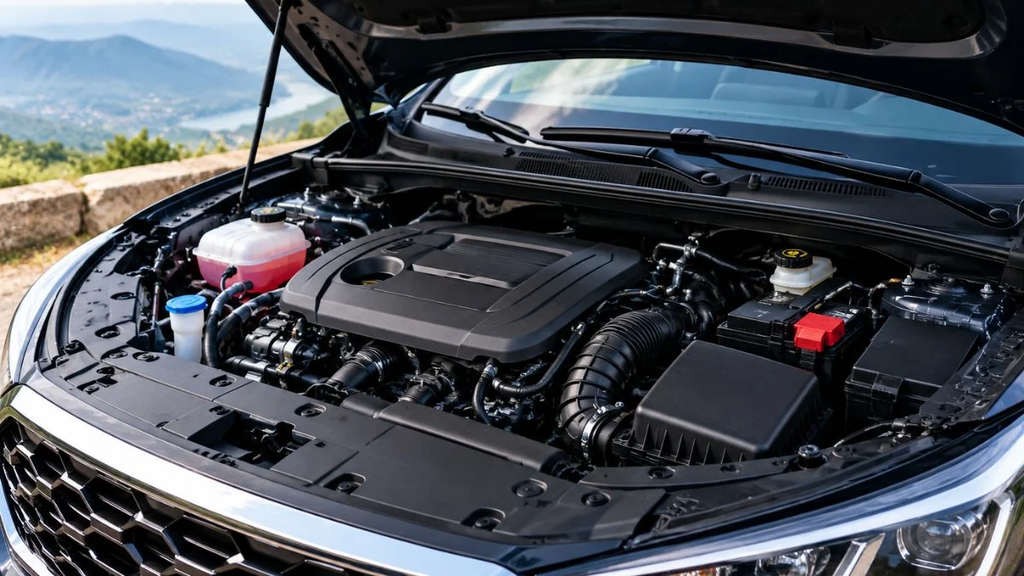
A car engine is the heart of every traditional gasoline or diesel vehicle, converting fuel into the power needed to keep your car moving. Understanding how an engine works can help you make smarter vehicle-buying decisions, recognize warning signs, and avoid costly repairs. From essential engine parts to different engine types, every component plays an important role in vehicle performance. Regular engine maintenance also helps improve reliability and reduce unnecessary wear. Whether you drive a sedan, SUV, or pickup truck, learning about engine performance and fuel efficiency is valuable for every driver. If you are considering a family vehicle, explore our SUVs: A Complete Guide for Car Buyers to learn about SUV types, benefits, fuel economy, and important buying considerations. In this guide, we will explore how car engines work, common problems, and practical maintenance tips to keep your vehicle running smoothly.
1. What Is a Car Engine and How Does It Work?
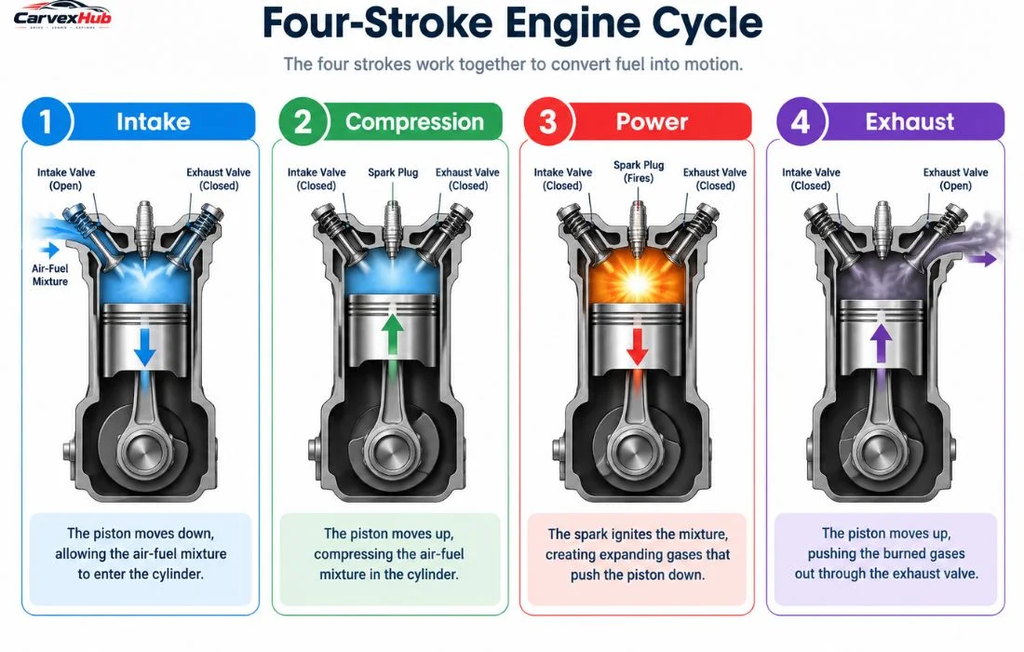
A car engine converts energy into mechanical power. In a gasoline or diesel vehicle, fuel burns inside the engine, creating pressure that pushes pistons and turns the crankshaft.
Most traditional vehicles use an internal combustion engine (ICE). Its components work together to produce power and send it through the drivetrain to the wheels.
The Four Strokes of an Engine
Many conventional engines use a four-stroke cycle to produce power.
- Intake: The piston moves down, allowing air or an air-fuel mixture into the cylinder.
- Compression: The piston moves up and compressing inside the cylinder.
- Power: Combustion creates expanding gases that push the piston down.
- Exhaust: The piston moves up again, pushing burned gases out through the exhaust valve.
Gasoline engines generally use spark plugs to ignite the mixture. Diesel engines ignite injected fuel using the heat created by highly compressed air.
This cycle repeats continuously to run the engine. The crankshaft converts the pistons’ movement into rotation, allowing the drivetrain to move the vehicle.
2. Main Parts of a Car Engine.
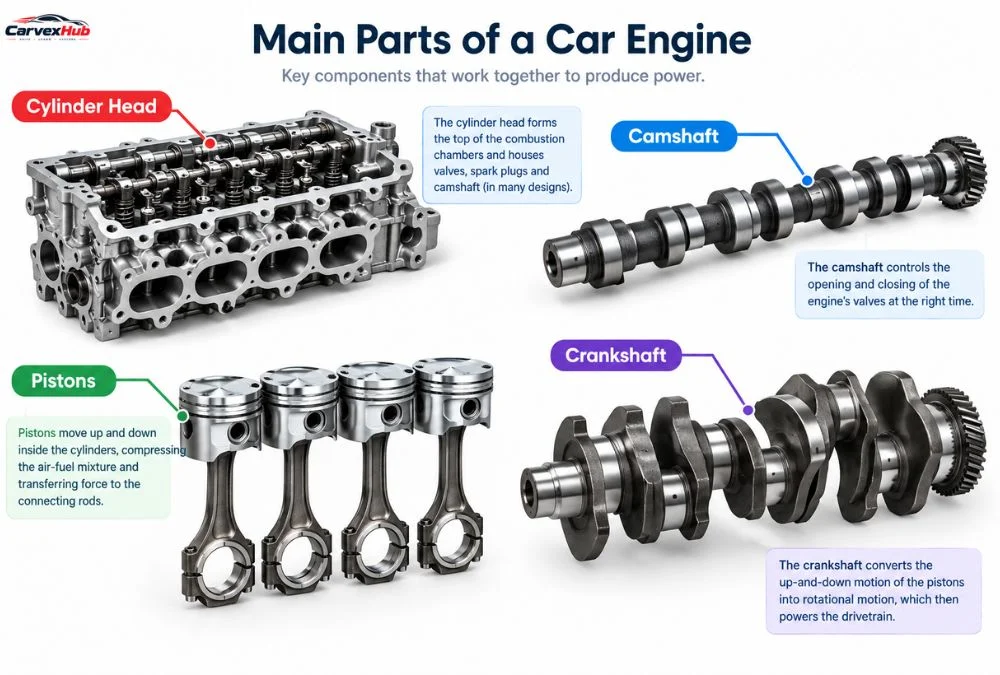
Every major engine component has a specific job. When these parts work together correctly, the engine can deliver reliable power and performance.
Here are the essential car engine parts every driver should know.
| Engine Part | Main Function |
| Engine block | Houses the cylinders and supports major components |
| Cylinder head | Forms the top of the combustion chambers |
| Pistons | Move under pressure created by combustion |
| Connecting rods | Transfer force from pistons to the crankshaft |
| Crankshaft | Converts piston movement into rotation |
| Camshaft | Controls the opening and closing of valves |
| Spark plugs | Ignite the mixture in gasoline engines |
| Fuel injectors | Deliver fuel into the engine |
| Oil pump | Circulates oil to lubricate moving parts |
| Water pump | Circulates coolant in many liquid-cooled engines |
How Do Engine Parts Work Together?
The fuel system delivers fuel, while the intake system supplies air. The pistons compress the contents of the cylinders, and combustion creates the force needed to rotate the crankshaft.
Meanwhile, the lubrication system reduces friction, and the cooling system helps control engine temperature. The engine control unit (ECU) uses sensor information to manage important functions.
Why does this matter? A problem with one component can affect the entire engine. Recognizing unusual noises, leaks, or warning lights can help you seek repairs before damage becomes more serious.
3. What Are the Different Types of Car Engines?
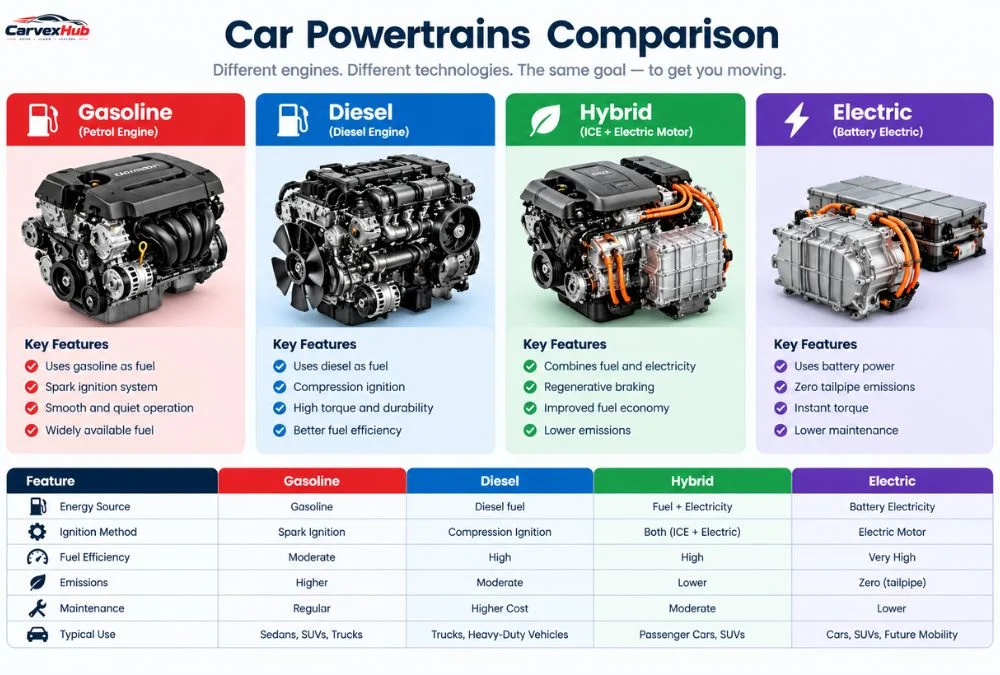
Different engine types suit different driving needs. Some focus on fuel economy, while others provide strong torque, higher performance, or a combination of benefits.
Gasoline Engines
Gasoline engines are common in American sedans, SUVs, and pickup trucks. They typically use spark plugs to ignite an air-fuel mixture.
Advantages:
- Widely available fuel.
- Smooth and relatively quiet operation.
- A wide selection of vehicle sizes and performance levels.
Limitations:
- Produce exhaust emissions during operation.
- Require regular maintenance.
- Fuel economy varies by vehicle and driving conditions.
Diesel Engines
Diesel engines use highly compressed air to create the conditions needed for fuel ignition. They are often found in heavy-duty trucks and vehicles .
Advantages:
- Strong low-speed torque in many applications.
- Good fuel efficiency in suitable vehicles.
- Useful for certain heavy-duty workloads.
Limitations:
- Some models have higher repair costs.
- Emissions-control systems require maintenance.
- Cold-weather operation can require special considerations.
Hybrid and Electric Powertrains
Hybrid vehicles combine an internal combustion engine with an electric motor and battery. Depending on the design, the motor can assist acceleration or move the vehicle under certain conditions.
Plug-in hybrids can also charge their batteries externally.
Battery-electric vehicles use electric motors rather than combustion engines for propulsion.
| Feature | Gasoline | Diesel | Hybrid | Battery-Electric |
| Energy source | Gasoline | Diesel fuel | Fuel and electricity | Electricity |
| Combustion engine | Yes | Yes | Yes | No |
| Electric motor | Usually no | Usually no | Yes | Yes |
| Tailpipe emissions | Yes | Yes | Yes when the engine runs | None |
| Main consideration | Fuel and maintenance | Torque and operating costs | Efficiency and battery system | Charging access and range |
The right choice depends on your budget, driving habits, charging access, and vehicle requirements.
4. What Are the Different Engine Configurations?
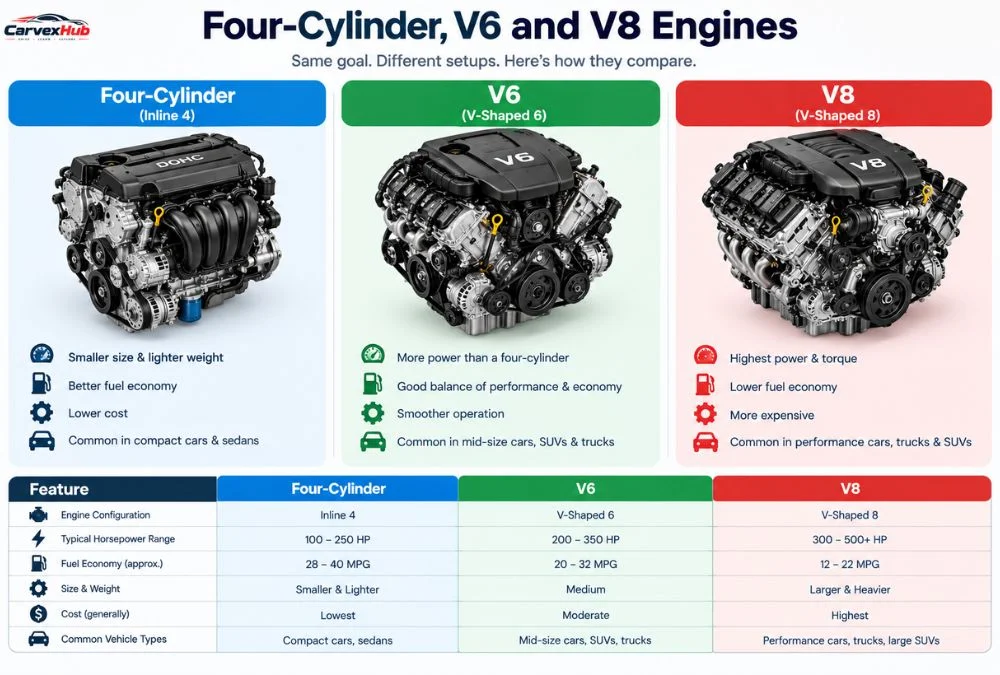
Engine configuration describes how cylinders are arranged. It affects engine size, packaging, smoothness, and performance.
Inline Engines
Inline engines place all cylinders in one row.
- Inline-3: Often used in compact, efficiency-focused vehicles.
- Inline-4: Common in sedans and compact SUVs.
- Inline-6: Can provide smooth operation but requires more space lengthwise.
V6 and V8 Engines
V-type engines arrange cylinders in two banks.
A V6 engine has six cylinders and is common in many midsize SUVs and trucks. A V8 engine has eight cylinders and is often selected for high-performance vehicles and demanding towing applications.
V8 engines can provide substantial power, but fuel consumption depends on engine design, vehicle weight, and driving conditions.
Four-Cylinder vs. V6: Which Is Better?
| Feature | Four-Cylinder | V6 |
| Cylinders | 4 | 6 |
| Common use | Compact cars and many SUVs | Midsize SUVs and larger vehicles |
| Fuel economy | Often better in comparable vehicles | May use more fuel |
| Power potential | Can be high, especially with turbocharging | Often provides greater power potential |
| Best for | Everyday driving and efficiency | Drivers needing additional power |
A turbocharged four-cylinder can outperform some V6 engines. Compare horsepower, torque, fuel economy, reliability, and towing capacity rather than choosing by cylinder count alone.
…………………………………………………
5. What Are the Main Engine Systems and How Do They Work?
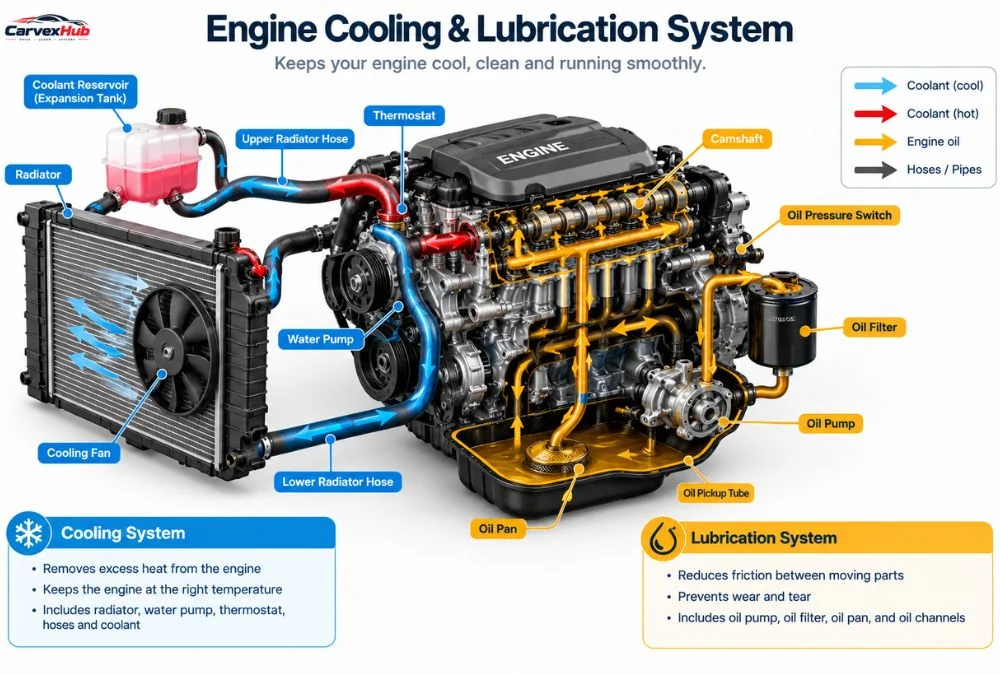
An engine relies on several supporting systems to operate safely and efficiently. Each system performs a different job.
Fuel and Air Intake Systems
The fuel system delivers fuel and the air intake system supplies air ..
A clogged air filter, faulty fuel injector, or malfunctioning sensor can contribute to reduced performance. However, proper diagnosis is needed because similar symptoms can have different causes.
Ignition and Starting Systems
Gasoline engines use spark plugs and ignition coils to initiate combustion. The starting system uses a battery and starter motor to crank the engine.
Common starting problems include a weak battery, corroded connections, a faulty starter, or fuel delivery issues.
Cooling System
The cooling system helps prevent excessive engine heat. Common components include the radiator, coolant pump, thermostat, hoses, and cooling fan.
Safety tip: If the engine overheats, shut it off .. Never open a hot radiator cap because pressurized coolant can cause severe burns.
Lubrication System
Engine oil reduces friction between moving components and helps carry heat and contaminants away from critical surfaces.
Low oil levels can cause serious damage. Always use the proper recommended oil.
Exhaust and Electrical Systems
The exhaust system carries combustion gases away and helps control noise and emissions. Components may include the catalytic converter and oxygen sensors.
The ECU uses sensor information to manage engine operation. Electrical faults can cause warning lights, rough running, or starting difficulties.
6. What Are the Most Common Car Engine Problems?
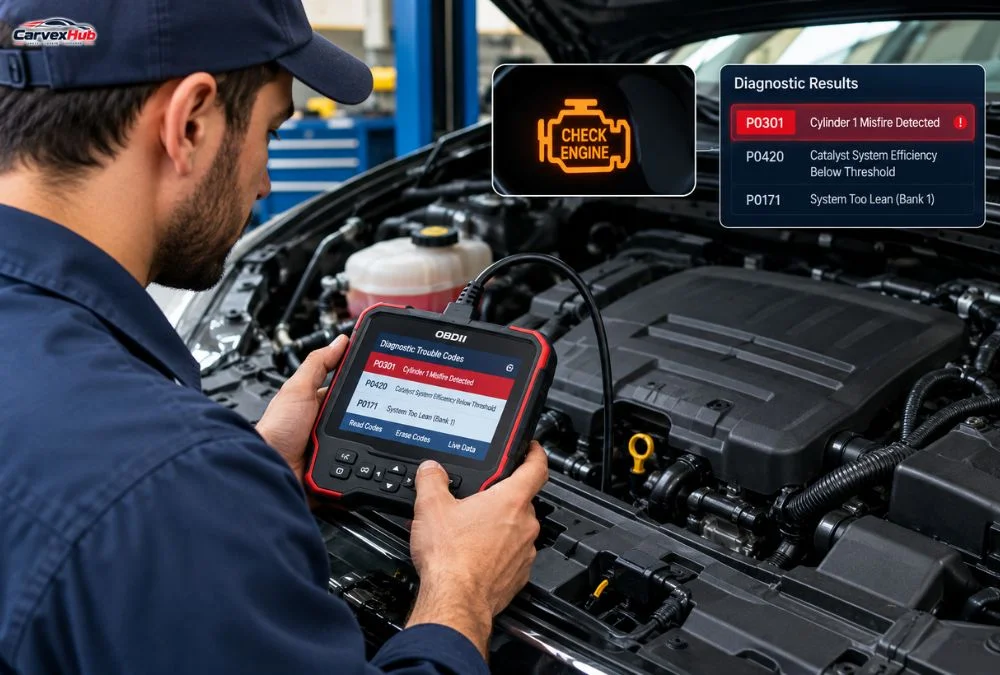
Engine problems often begin with warning signs.understanding them to prevent more serious damage.
Engine Overheating
Overheating can result from low coolant, leaks, a faulty thermostat, radiator problems, or water pump failure.
If a temperature warning appears, stop driving safely to cool the engine. Never remove a cooling-system cap while it is hot.
Oil Leaks and Low Oil Pressure
Oil leaks can develop around seals, gaskets, or filters. You may notice oil spots beneath the vehicle or a burning-oil smell.
Low oil pressure is more urgent. If the oil-pressure warning light comes on while driving, stop driving and shut off the engine. Take assistance before restarting if the cause is unknown.
Engine Misfires
A misfire occurs when combustion does not happen properly in one or more cylinders.
Possible symptoms include:
- Engine shaking or rough idling.
- Hesitation during acceleration.
- Reduced power.
- Increased fuel consumption.
- A check engine light.
If a flashing check engine light on, Stop driving immediately and take assistancy .
Unusual Noises and Exhaust Smoke
Knocking, ticking, squealing, or grinding sounds can indicate engine or accessory problems. Exhaust smoke also provides clues:
| Exhaust Appearance | Possible Cause |
| Blue or blue-gray smoke | Engine oil may be burning |
| Persistent thick white smoke | Coolant may be entering the combustion chamber |
| Black smoke | Excess fuel or incomplete combustion |
| Thin white vapor in cold weather | Normal condensation |
Persistent smoke, unexplained fluid loss, or unusual engine noises should be inspected promptly.
7. How Can You Maintain a Car Engine?
Regular engine maintenance helps reduce unnecessary wear and may prevent avoidable repairs. Always follow the maintenance schedule of your . vehicle.
Change Engine Oil on Time
Engine oil lubricates moving parts and helpsto reduce heat. Check your owner’s manual for the correct oil specification and replacement interval. Replace the oil filter as recommended, and do not assume every vehicle needs the same service schedule.
Check Coolant and Air Filters
Check coolant levels when the engine is cool and look for leaks or damaged hoses. Use only the coolant specification recommended by the manufacturer.
Change the air filter when necessary to maintain proper airflow.
Inspect Spark Plugs, Belts, and Hoses
Worn spark plugs can cause to misfires in gasoline engines. Belts and hoses should also be checked for visible wear, cracking, or damage.
Some engines use timing belts that require replacement at specified intervals. Ignoring this requirement can cause severe damage in certain engine designs.
Simple Engine Maintenance Checklist
| Task | Recommended Action |
| Engine oil | Check according to the owner’s manual |
| Oil and filter | Replace at the specified interval |
| Coolant | Check when the engine is cool |
| Air filter | Inspect and replace as recommended |
| Belts and hoses | Inspect for wear or damage |
| Warning lights | Investigate promptly |
| Timing belt, if fitted | Follow the specified replacement schedule |
Consistent maintenance cannot prevent every failure, but it can help you identify problems before they become more serious.
8. How Long Does a Car Engine Last?
An engine’s lifespan depends on its design, maintenance, mileage, and operating conditions. Many modern vehicles can reach 200,000 miles or more, but this is not guaranteed for every engine.
Regular servicing, proper lubrication, and a healthy cooling system help reduce avoidable wear. Frequent overheating and neglected maintenance can shorten engine life.
When You Repair or Replace an Engine?
A repair may be suitable when a specific component fails. An engine rebuild involves repairing or replacing internal components, while a replacement involves installing another engine.
Before deciding, compare the total cost of parts and labor, available warranties, and the condition of the rest of the vehicle.
If you are buying a used car, review service records and consider an independent pre-purchase inspection. Mileage matters, but maintenance history and actual engine condition are equally important considerations. If you are planning to buy a vehicle, our guide to new car reviews can help you understand which features and factors to consider when comparing cars.
Conclusion
Understanding how a car engine works helps you make smarter decisions about vehicle maintenance, repairs, and used-car purchases. Knowing the main engine parts, powertrain types, and common warning signs can make car ownership easier.
For better long-term reliability, follow your manufacturer’s service schedule, use the correct fluids, and address unusual noises, leaks, or warning lights promptly.
Regular maintenance cannot eliminate every problem, but it can help reduce avoidable damage and keep your vehicle running reliably for years.
9. Frequently Asked Questions About Car Engines
How Does a Car Engine Work in Simple Terms?
A conventional engine burns fuel inside cylinders. Expanding gases push pistons, rotate the crankshaft, and help deliver power to the wheels.
What Are the Main Parts of a Car Engine?
Major components include the engine block, cylinder head, pistons, connecting rods, crankshaft, camshaft, valves, and fuel delivery components.
How Often Should You Change Engine Oil?
The interval depends on your vehicle, oil specification, and driving conditions. Follow the manufacturer’s maintenance schedule.
What Causes a Car Engine to Overheat?
Common causes include low coolant, leaks, a faulty thermostat, radiator problems, and water pump failure.
How Can You Tell If an Engine Is Failing?
Warning signs may include persistent overheating, low oil pressure, unusual knocking, excessive smoke, repeated misfires, or significant power loss. Professional diagnosis is important.
