
Have you ever looked closely at your vehicle’s tire and wondered what all those numbers and letters mean, like P215/65R15 95H? This information is confusing. But a very important detail is hidden in these few characters about the tires, which tells about its dimensions,construction, load and speed rating. You can understand what these numbers on tires mean? This makes buying replacement tires very easy. IThis also helps in choosing your tire options and saves you from choosing an unsuitable size. In this guide, you’ll learn how to read tire size markings, understand common sidewall symbols, and find the right tires for your vehicle.
1. Where Can You Find Tire Size Numbers?
The easiest place to find tire size information is the tire sidewall. If you can look at the outer surface of your tire for a compound of letters and numbers, for example P215/65R15 95H.
You can also find your vehicle’s Suggested tire size on the driver’s door-jamb label or manually in the owner’s manual. These references will be especially helpful for you when you will buy new tires.
Important: Never consider the tires currently fixed are the correct size. A previous owner may have fitted different tires. You should always check your vehicle producer’s recommended requirements before purchasing replacements.Tire size is just one factor to consider when choosing replacement tires. For more guidance, explore our complete guide to car tire types, reviews, and maintenance to learn about tire selection, performance, and care.
2. How to Read Tire Size Numbers and Letters
Now we should decode the code printed on a typical car tire : P215/65R15 95H.
Each part has a different purpose. All these markings together help you understand the tire’s dimensions and its performance.
| Marking | What it means |
| P | Passenger tire in the P-metric system |
| 215 | Nominal tire width in millimeters |
| 65 | Aspect ratio |
| R | Radial construction |
| 15 | Wheel diameter in inches |
| 95 | Load index |
| H | Speed rating |

You don’t need to memorize every code. It can be very easy to read tire numbers if you understand the presentation of each part.
3. What Does Each Part of a Tire Size Mean?
What Does the P Mean on a Tire?
The letter P locates a vehicle tire in the P-metric sizing system. These tires are commonly used on passenger cars and some SUVs.
You can also see LT, which verifies a light-truck tire, or ST, which recognizes a special-trailer tire. Some tires use Euro-metric sizing conventions instead.These categories are not interchangeable in every situation.Choose the type of tire for your vehicle that fulfils its requirements and usage.
What Does the Tire Width Number Mean?
In P215/65R15, the number 215indicates the width of the tire in millimeters. This shows the tire’ width from sidewall to sidewall, rather than just the part of the tread that touches the road.
A wider tire may change handling, steering response, and rolling resistance. the result depends on the tire design and vehicle.
Choose a width approved for your car instead of selecting a tire based only on its appearance.
What Is the Tire Aspect Ratio?
The number 65 represents the aspect ratio. It means that the height of the tire’s section is approximately 65% of its normal width.
For a tire with a width of 215 mm, the calculation is:
215 × 0.65 = approximately 140 mm.
This measurement describes the height of one sidewall, not the tire’s total diameter. Generally, a lower aspect ratio means a shorter sidewall, whereas a higher aspect ratio generally means a taller sidewall.
What Does R Mean on a Tire?
The letter R stands for radial construction. In a radial tire, the layers of internal cords are laid radially throughout the tire.
Radial tires are very commonly used in fashionable passenger vehicles. You also have to deal with the construction of special tires.
You should always follow the construction type specified for your vehicle. It does not depend only on the tire size.
What Does the Last Number Mean?
The wheel diameter in inches represents the number 15 in P215/65R15. This tire indicates to you the diameter of the wheel it is designed to fit.
It is different from the tire’s overall outside diameter. A tire designed for a 15-inch wheel cannot simply be fitted to a 17-inch wheel.
The wheel diameter must match exactly, and the complete tire must also meet the vehicle’s fitment requirements.
4. Common Tire Size Examples Explained.
Understanding tire size numbers becomes easy through examples. Consider these three markings:
| Tire code | Basic information |
| P215/65R15 95H | 215 mm width, 65 aspect ratio, radial construction, 15-inch wheel |
| P225/65R17 102H | 225 mm width, 65 aspect ratio, radial construction, 17-inch wheel |
| LT245/75R16 | Light-truck tire, 245 mm width, 75 aspect ratio, 16-inch wheel |
The second example is wider and fits into a bigger wheel than the first one. Its load index is also different.
A tire size chart can help you compare measurements, but it cannot confirm whether a particular size is safe for your vehicle. Overall diameter, clearance, load capacity, and manufacturer recommendations also matter.
Please ask a professional to check compatibility before changing the tire size..
5. How to Read Tire Load Index and Speed Ratings
After the size, you may see a number and a letter such as 95H. These symboles indicate the load and speed limits.
For example, in this case , the load index number is 95. It corresponds to a standardized maximum load capacity for a single tire under specified conditions. The exact capacity should be checked using a reliable load-index chart.
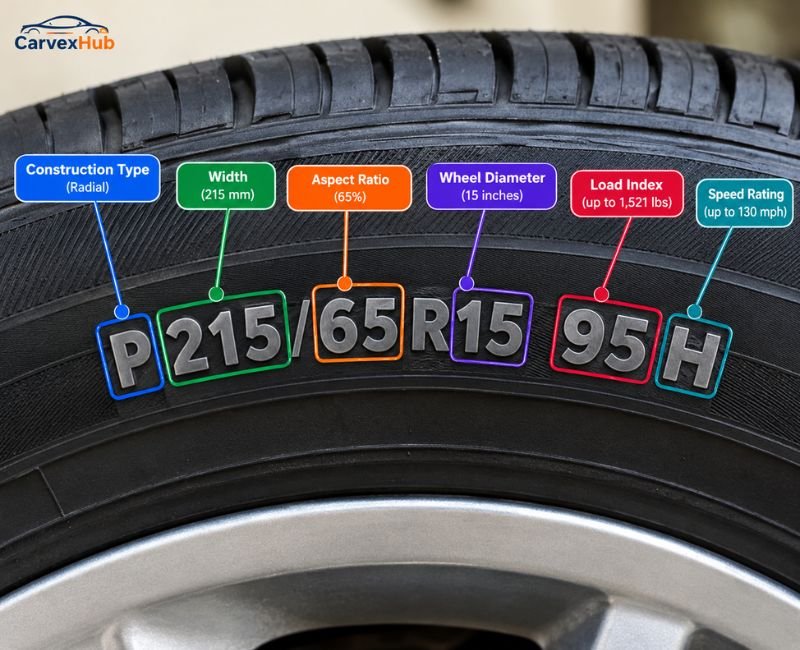
The letter H is the speed rating. H corresponds to a rated maximum speed of 130 mph under specified test conditions.
This speed limit does not mean that you should always drive at this speed. Always follow the prescribed speed limits and drive according to environment and traffic conditions.
When buying a tire , make sure it fulfills your vehicle”s need
6. What Do Other Tire Sidewall Markings Mean?
Your tire sidewall may contain several additional symbols. Understanding them can help you identify the tire’s intended use.
XL means Extra Load. These tires are designed for higher load capacity under specified conditions when used at the appropriate pressure.
M+S stands for mud and snow.k the tire maker’s information rather than guessing its meaning.

7. How to Read Tire Pressure and DOT Date Codes
Two important details on a tire are its pressure information and manufacturing date.
The sidewall may show maximum air pressure and ma It is a designation associated with certain tread designs, but it does not automatically mean the tire meets a dedicated severe-snow traction standard.
The three-peak mountain snowflake symbol indicates that a tire meets specific snow-traction performance requirements. It can help drivers identify tires designed for qualifying severe-snow conditions.
You may also see “Tubeless,” the manufacturer’s name, and original-equipment markings. If a symbol is unfamiliar, checximum load information. However, the maximum pressure printed on the tire is not necessarily the correct everyday inflation pressure for your vehicle.
For the recommended tire pressure, check the driver’s door-jamb label or owner’s manual. Follow the vehicle manufacturer’s guidance, and check tire pressure when the tires are cold.
How to Find the Tire Manufacturing Date

Look for the DOT identification markings on the sidewall. On modern tires, the final four digits of the date code indicate the manufacturing week and year.
For example, 2325 means the tire was manufactured during the 23rd week of 2025.
Knowing the tire manufacturing date can help you assess tire age. However, age is only one consideration. Inspect tires for cracks, damage, tread wear, and other signs of deterioration, and follow the tire manufacturer’s recommendations for inspection and replacement.
8. What Are Treadwear, Traction, and Temperature Ratings?
Some passenger tires sold in the USA display Uniform Tire Quality Grading (UTQG) information. It includes treadwear, traction, and temperature grades.
Treadwear rating: This provides a relative comparison of tread wear under specified testing conditions. It is not a guaranteed mileage estimate.
Traction rating: This relates to wet-braking performance under the applicable test conditions. It does not describe every aspect of grip in every weather condition.
Temperature rating: This indicates a tire’s ability to resist heat under specified testing conditions.
These ratings can help when comparing eligible tires, but they should not be your only deciding factors. Tire type, road conditions, driving habits, and maintenance also affect real-world performance.
Not every tire category carries UTQG ratings, so check the information available for the tire you are considering.
9. Why Choosing the Correct Tire Size Matters
The correct tire size helps your vehicle maintain its intended handling, clearance, and performance. An unsuitable size may affect speedometer accuracy, steering, or clearance around suspension and body components.If your vehicle shakes or vibrates when you apply the brakes, the cause could involve the tires, brake rotors, or suspension components.
Read our guide to 7 causes of car vibration when braking and their fixes to learn about possible warning signs and next steps.
Imagine fitting a tire that is too large for the available wheel-well space. It may rub against nearby components during turns or when the suspension moves.
The wrong load rating can also be a concern, especially when carrying passengers or cargo. That is why matching the size alone is not enough.
Before choosing replacement tires, confirm the approved dimensions, load index, speed rating, and other requirements in your vehicle documentation.
10. How to Choose the Right Replacement Tire Size
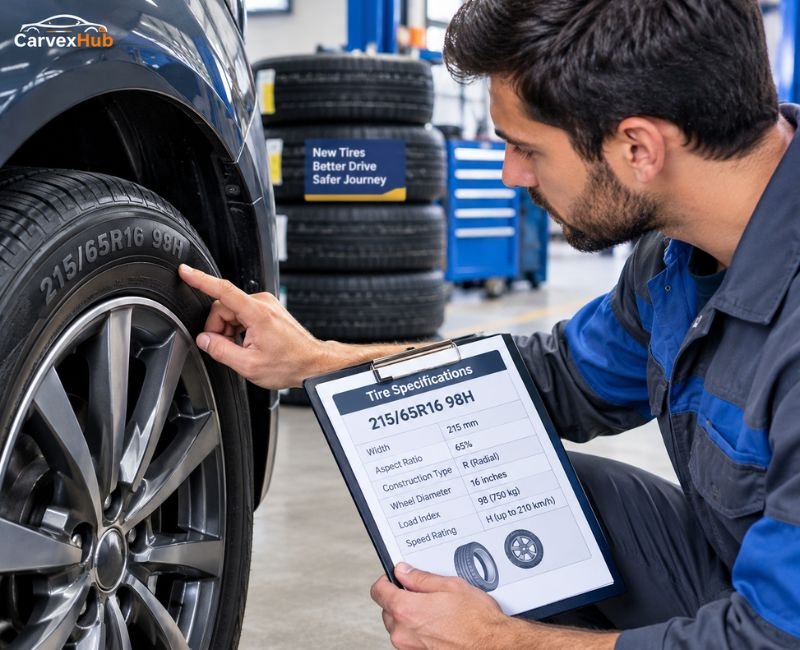
Choosing replacement tires becomes easier when you follow a few practical steps.
First, check the recommended size on the driver’s door-jamb label or in your owner’s manual. Compare it with the markings on your current tires, but use the manufacturer’s specifications as your main reference.
Next, confirm the load index and speed rating. If your vehicle uses different tire sizes on the front and rear axles, check both specifications before ordering.
Think about where you drive, too. All-season tires suit many everyday driving needs, while summer and winter tires are designed for different temperature and road conditions. All-terrain tires may be appropriate for certain vehicles and driving environments.
Finally, consider tread condition, tire age, warranty, and your budget. If you want to change the original tire size, consult a qualified tire professional who can check wheel fitment, clearance, and load capacity.
Conclusion
Understanding what the numbers on tires mean makes it easier to compare tires and choose suitable replacements. The markings tell you about tire width, aspect ratio, wheel diameter, construction, load capacity, and speed rating.
Before buying new tires, confirm the recommended size and ratings for your vehicle. Check the correct inflation pressure separately from the maximum pressure shown on the sidewall, and pay attention to tire condition and age.
A few minutes spent reading these markings can help you make a more informed tire choice and support safer driving.
Frequently Asked Questions About Tire Numbers
What do the numbers on tires mean?
They describe important tire details, including nominal width, aspect ratio, wheel diameter, and load index. Letters identify information such as tire type, construction, and speed rating.
What does R mean on a tire?
R stands for radial construction. It describes how the tire’s internal cord layers are arranged.
What does H mean on a tire?
H is a speed rating corresponding to 130 mph under specified conditions. It is a technical rating, not a recommended driving speed.
How do I find my tire’s manufacturing date?
Look for the DOT identification markings and locate the final four digits of the date code on a modern tire. These digits indicate the production week and year.
Can I use a different tire size on my car?
Sometimes an alternative size is suitable, but it must meet the vehicle’s requirements for fitment, load, and speed ratings. Confirm compatibility with the manufacturer or a qualified tire professional before changing sizes.
Where can I find the correct tire size for my vehicle?
Check the driver’s door-jamb label or owner’s manual. The tire sidewall is also useful for comparison, but verify that the installed tires match the vehicle’s specifications.
