
Brakes are the most important part of a car. Every time you press the pedal, a brake system of many parts works together to slow you down. The brake pads squeeze the brake rotors, and hydraulic fluid carries your foot’s force to each wheel. When one part wears out, your stopping power drops fast. Understanding how your brake system works ensures you can maintain or replace it correctly and safely. Knowledge keeps you safe on the road.
How Do Car Brakes Work? (Brake System Basics)
Friction Turns Motion Into Heat
Car brakes work by friction. When you press the pedal, the brake pads press against a spinning metal disc. This rubbing slows the wheel. The motion of your car turns into heat, and your car loses speed. Good stopping power depends on strong friction and a healthy brake system.
From Pedal to Wheel: Hydraulic Pressure at Work

Your foot does not stop the car alone. Pedal pushes a piston in the master cylinder. That push creates hydraulic pressure in the hydraulic fluid. The fluid travels through the brake lines to each wheel. At the wheel, the caliper piston pushes the pads on to the rotor. Modern cars also use ABS, which stops the wheels from locking during hard braking.
Main Parts of a Car Brake System
The Parts You Can See and Touch
Every car brake system has several key parts. The brake pads press on the rotors. The brake rotors are metal discs that spin with the wheel. The brake calipers hold the pads and squeeze them. The brake lines carry fluid, and the master cylinder pushes that fluid out. The brake reservoir sits under the hood and stores extra fluid. Small parts matter too. Brake hardware / hardware clips hold the pads in place and let them move freely.
Small Parts That Do Big Jobs
Pads have wear indicators. These are small metal tabs that squeal when the pad gets thin. A bleeder valve on each caliper lets you remove trapped air from the system. The brake booster adds force so the pedal feels light. The parking brake gives you a backup way to hold the car. The table below shows each part, its job, and a common problem.

| Part | What It Does | Common Problem |
| Brake pads | Press on rotors to slow the wheel | Thin pads, noise |
| Brake rotors | Give pads a surface to grip | Warping, rust, deep grooves |
| Brake calipers | Squeeze the pads | Seized caliper piston |
| Brake lines | Carry hydraulic fluid | Leaks, rust |
| Master cylinder | Pushes fluid to the wheels | Soft pedal, leaks |
| Brake fluid | Passes pressure along | Moisture, dark color |
| Hardware clips | Hold pads in place | Rust, bent clips |
Types of Car Brakes: Disc, Drum, ABS and Regenerative
Disc Brakes and Drum Brakes
Most modern cars use disc brakes on the front wheels. They shed heat well and give strong stopping power. Some cars use drum brakes on the rear wheels. In a drum brake, shoes push outward against the inside of a drum. Drums cost less to build and work well for light rear-brake duty. Many drivers ask which type is better, and the table below gives a quick answer.

| Feature | Disc Brakes | Drum Brakes |
| Heat control | Very good | Fair |
| Wet weather | Dries fast | Can hold moisture |
| Cost | Higher | Lower |
| Typical use | Front, often rear too | Rear on many budget cars |
| Maintenance | Easier to inspect | Harder to inspect |
ABS and Regenerative Braking
ABS stands for anti-lock braking system. Sensors watch each wheel. If a wheel is about to lock, the system pulses the brakes fast. This helps you keep steering control on wet or icy roads. Hybrids and EVs use regenerative braking. The electric motor slows the car and sends power back to the battery. Because the pads work less, EV rotors can sit unused and rust faster. A few firm stops now and then can help keep them clean.
Brake Pads and Rotors: Choosing the Right Type
Ceramic, Semi-Metallic and Organic Pads
The brake pad material changes how your car stops. Ceramic pads are quiet and make little dust. Semi-metallic pads grip well and handle heat, so they suit trucks and towing. Organic pads are soft and quiet, but they wear faster. Pick the type that matches your driving, not just the lowest price.
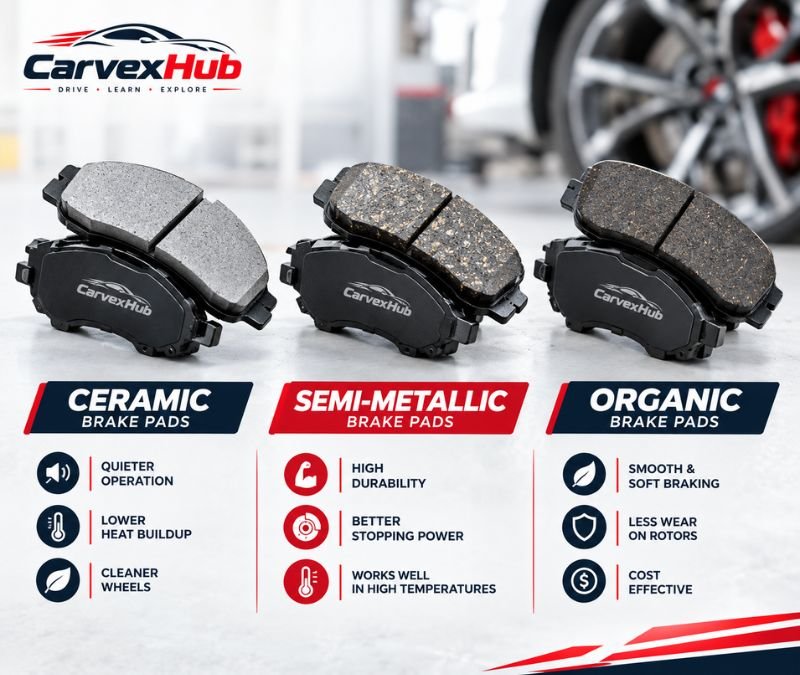
| Pad Type | Noise | Dust | Heat Handling | Best For |
| Ceramic | Very quiet | Low | Good | Daily commuting |
| Semi-metallic | Can be noisy | Higher | Very good | Towing, SUVs, trucks |
| Organic | Quiet | Medium | Fair | Light, gentle driving |
Plain, Drilled, Slotted and Dimpled Rotors

Plain rotors are a reliable choice for standard driving. While drilled, slotted, and dimpled rotors offer better heat and dust control for performance driving, everyday vehicles rarely require them.. A brake kit can save money over buying pads and rotors one by one, so compare prices before you buy. Always bring parts according to your vehicle’s model.
Warning Signs Your Brakes Need Attention
Sounds and Smells You Should Not Ignore
Your brakes warn you before they fail. A high squeal often means the wear indicators are touching the rotor. A deep grinding sound can mean the pad is gone and you have metal-on-metal contact. A burning smell can mean hot brakes or a stuck caliper piston. Do not wait when you notice these signs. Early detection keeps repairs small and cheap.
Feelings Through the Pedal and Wheel
A soft or spongy pedal can mean air in the lines or low fluid in the reservoir, while a vibrating steering wheel often points to warped rotors. If the car pulls to one side, you may have a stuck caliper, a suspension issue, or poor alignment.The brake warning light on the dash also needs a quick check. Use the table below for guidence.

| Symptom | Likely Cause | How Urgent |
| Squealing | Worn pads, wear indicators | Soon |
| Grinding | No pad left | Very urgent |
| Spongy pedal | Air or low hydraulic fluid | Urgent |
| Pedal pulsing | Warped rotors | Soon |
| Pulling to one side | Stuck caliper, alignment | Urgent |
| Warning light | Many causes | Check now……………………………… |
When to Replace Brake Pads, Rotors and Other Parts
How Long Brake Pads and Rotors Last

Brake pad life depends on your driving style and brake pad material. City driving and heavy loads wear pads faster. Many pads last somewhere between 25,000 and 70,000 miles, but your owner’s manual and mechanic give the best advice. If the pad is thinner than about 3 mm, replace it. That is about the width of two credit cards. Rotors often last longer than pads. Replace them if you face trouble, or a thickness below the minimum stamped on the rotor.
Other Parts and Cost Factors
Calipers, brake lines, sensors and brake hardware / hardware clips also wear out. Replace rusty clips when you change pads, because they help the pads move smoothly. Brake job costs in the USA vary a lot. Your vehicle type, part quality, local labor rates and the work needed all change the price. Ask for a written quote before work begins. Always replace pads on both sides of the same axle at the same time. This keeps your braking balanced.
Brake Maintenance Tips: What You Can Do Yourself
Simple Checks You Can Do at Home
Many brake tasks are easy for a careful DIYer. Look at your pads through the wheel spokes. Check the fluid level in the brake reservoir often. Brake fluid is hygroscopic, which means it absorbs moisture . Many makers suggest a change about every two years. Use the fluid grade in your owner’s manual, such as DOT 3, DOT 4 or DOT 5.1. Do not mix DOT 5 silicone fluid with the others.
A Basic Pad Change, Step by Step
You need gloves, goggles, a jack, jack stands, a lug wrench, a socket set, a c-clamp and a torque wrench. Work on a cool car. The basic steps are below.
- Loosen the lug nuts, lift the car and remove the wheel.
- Remove the caliper and slide out the old pads.
- Compress the caliper piston with a c-clamp.
- Fit the new pads and clean the clips with brake cleaner.
- Put grease only on the pad backs and hardware, never on the pad face or rotor.
- Refit the wheel and tighten the lug nuts to torque specs.
If the pedal feels soft afterward, you may need to bleed the brakes. Open the bleeder valve while a helper presses the pedal. Start with the wheel farthest from the master cylinder. Then “bed in” the new pads with several gentle stops, as the pad maker advises. Leave ABS light problems to a pro with a scan tool.
Quick tip: Knowing what not to DIY is as important as knowing what you can do.
Brake Care in Different Conditions
Heat, Towing and Mountain Roads
Heat is the enemy of brakes. Long downhill drives, heavy traffic, and towing can cause brake fade—a dangerous drop in stopping power caused by overheating. On steep hills, shift to a lower gear to let the engine assist in slowing the car. If you tow frequently, opt for high-heat-resistant pads, such as semi-metallic ones, and inspect your brakes regularly before long trips.
Winter, Rain and Rust
Winter brings cold, road salt and rust. Salt can attack rotors, calipers and brake lines. Rinse the underside of your car after salty drives. In rain and snow, leave more space and brake early and smoothly. Your ABS will pulse under your foot on slick roads. This is normal, so keep steady pressure on the pedal. EV owners should watch for rotor rust, because regenerative braking uses the pads less.
Case study (example): A driver in a snowy state noticed a squeak every morning. The noise faded after a few miles, so they ignored it. Months later, a mechanic found rusted brake hardware / hardware clips and a sticky caliper piston. New clips and a caliper service fixed it at a modest cost. Checking sooner would have saved the pads too.
Common Brake Myths vs Facts
Myths About Parts and Noise
Many drivers believe things about brakes that are not true. Some think drilled rotors are always better. In truth, they help in hard driving but may not help a daily commuter. Others think every brake noise means a broken part. Light noise can come from dust, damp air or rough roads. Some believe ceramic pads are always best. The right choice depends on your driving style.
Myths About Habits and Service
Some drivers think brake fluid never needs a change. In fact, it absorbs water and loses strength over time. Others believe you only need a check when you hear a problem. A yearly inspection is safer. Many also think all pads are the same, but the brake pad material and quality differ a lot.
| Myth | Fact |
| Drilled rotors are always better | They suit hard driving more than daily use |
| All noise means a broken part | Some noise is harmless, but check it |
| Ceramic pads are always best | The best pad depends on your driving |
| Brake fluid never needs changing | It absorbs moisture and wears out |
| All brake pads are alike | Quality and brake pad material vary |
| Check brakes only when they fail | Regular checks catch problems early |
Conclusion
Car brakes are simple in idea but vital for your safety. Learn the key components, stay alert for warning signs, and replace worn items promptly. While minor maintenance can be done at home, complex repairs should be left to a certified mechanic. A little care today keeps your braking system safe and reliable for many miles to come.
Brake work affects your safety. When in doubt, see a certified mechanic.
Frequently Asked Questions About Car Brakes
FAQs:
How often should I replace my car brakes?
There is no single number. Pads often last tens of thousands of miles, but it depends on how you drive. Check them at least once a year.
Should I replace pads and rotors together?
Not always. Replace rotors if they are worn, grooved or warped. Many shops suggest new rotors with new pads for the best feel.
How much does a brake job cost in the US?
It varies by car, parts and labor. Ask for a written quote from a trusted shop.
Do I need a brake check for my state inspection?
Rules differ by state. Check with your local motor vehicle office.
Common Questions About Noise, Fluid and Safety
Why are my brakes squeaking or grinding?
Squeaking often means the wear indicators are touching the rotor. Grinding can mean the pad is gone. Get it checked fast.
How often should I change brake fluid?
Many makers suggest every two years. Your owner’s manual has the exact advice.
Can I drive with the brake warning light on?
It is not safe to ignore. Check the brake reservoir level and see a mechanic soon.
